
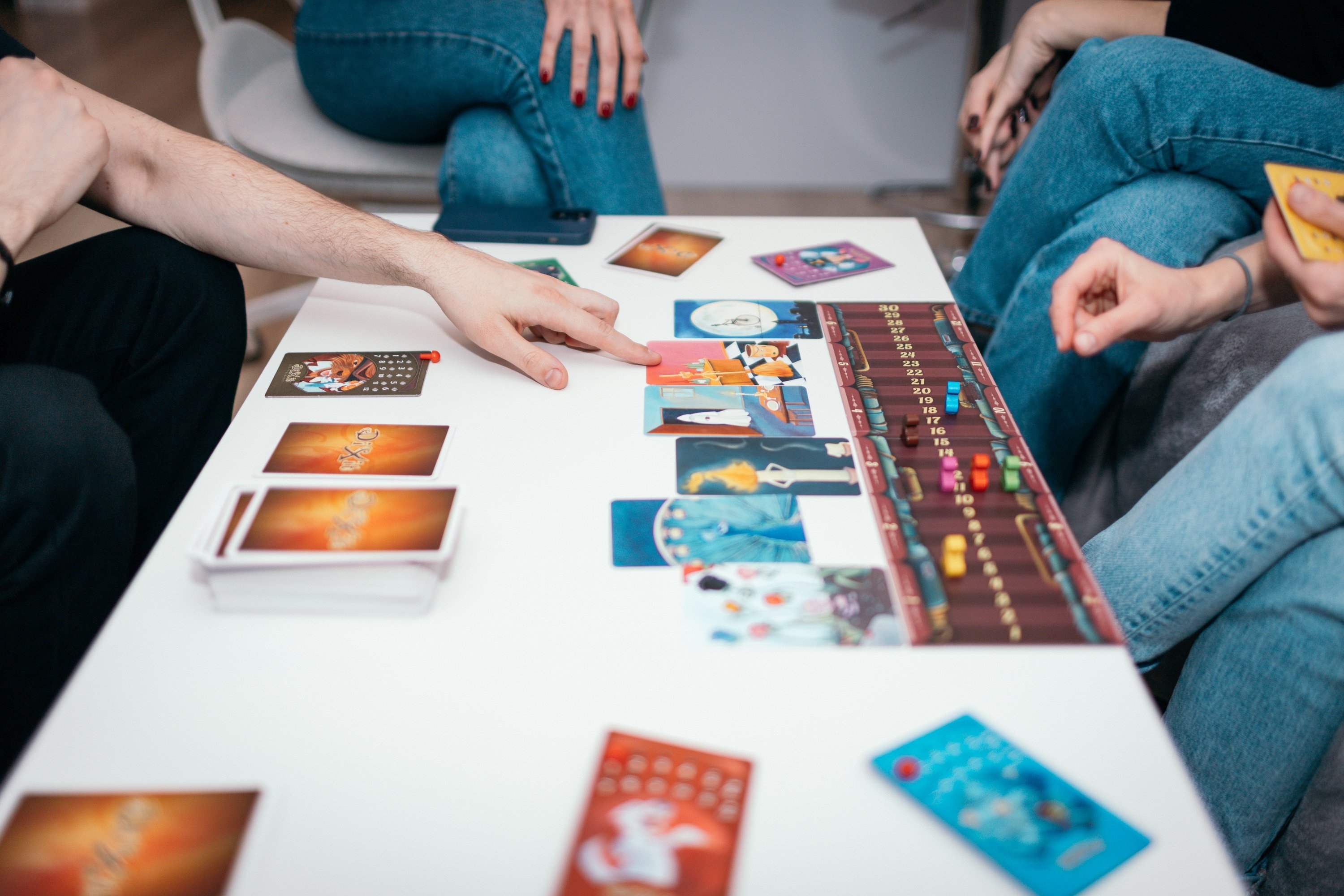
Board games as a bridge to togetherness
The first author of the article, José Luiz Amado, is a visiting researcher from Federal Institute of Triângulo Mineiro, Brazil in Haaga-Helia’s Pedagogy and Learning research area. His research focuses on the use of board games in education, particularly on how games can create meaningful learning experiences. In this article, he shares his insights together with his supervisor, Irma Kunnari, Principal Lecturer at Haaga-Helia School of Professional Teacher Education.
As Paulo Freire (1996) reminds us, teaching is a dialogical process: “Those who teach learn by teaching, and those who learn teach by learning.” Building on this, an excellent learning experience emerges when teachers and students position themselves as co-learners, entering the process with shared curiosity. However, several challenges stemming from learners, school structures, and persistent teacher-centred methods hinder this ideal.
Regarding learners, digital environments now shape the emotional conditions of learning. While technologies have enabled ”time-space compression” (Harvey, 1989), research suggests that internet addiction can increase feelings of loneliness (Smith & Aldeheini, 2023). This isolation grew during the COVID-19 pandemic; a 2025 poll by the Finnish Red Cross (Yle News, 2026) found that 65% of respondents felt lonely.
Furthermore, the European Parliament (2025) has proposed a minimum age of 16 for accessing social media and AI companions, reflecting how digital exposure and emotional vulnerability now directly affect learners’ well-being. This stems from findings that the pervasive nature of social media often creates a ’comparison trap’ that negatively impacts subjective well-being, while experiences of digital exclusion and lack of social recognition further undermine a young person’s fundamental sense of belonging (DigiGen, 2021).
An excellent learning experience emerges when teachers and students position themselves as co-learners, entering the process with shared curiosity.
Structural barriers in schools also appear to persist, as the institutional framework of modern education still carries a legacy from the industrial era. This influence remains visible in the spatial organisation of classrooms, where learners are frequently gathered in large groups and desks are arranged in rigid, linear rows. Such environments, designed for standardised instruction, can inadvertently prioritise mass delivery over the genuine socialisation and flexible interaction required for a high-quality learning experience.
Although John Dewey (1938) argued nearly a century ago that learners should be active participants rather than passive recipients, a persistent gap remains between pedagogical methods and classroom reality. Contemporary education is increasingly defined by socio-constructivist principles, which assert that learning is inherently social and that knowledge is constructed through interaction and collaboration with others (Vygotsky, 1978). This shift, further supported by Freirean thinking, redefines the teacher’s role: moving from a central authority to a facilitator who guides the development of lifelong competencies. However, many institutions remain caught in a struggle, anchored in traditional methods that often overlook the social nature of the learning process.
There is, therefore, a clear need for innovative pedagogical approaches. In this article, we aim to discuss how teachers can foster safer, more dialogic environments that promote togetherness and mitigate the growing sense of loneliness among learners. In doing so, we explore the potential of games with educational purposes, a.k.a. ’Serious Games’ (Abt, 1970), with a specific focus on educational board games rather than digital games. Board games possess a unique, tangible potential to enhance social competencies and collaborative learning in ways that digital platforms often struggle to achieve, providing a practical pathway to build togetherness for learning within the classroom.
Games – concept and origins
What differentiates a game from a mere task or a solitary puzzle is the voluntary acceptance of a shared reality. According to Järvilehto (2011, pp. 15–20), a game is defined by its goal-oriented structure and a set of constraints (rules) that players accept. In the context of building togetherness, this acceptance is a profoundly social act. By agreeing to the rules, players enter what is known in game studies as the ”Magic Circle”—a shared conceptual space where the outside world recedes and the collective experience of the group takes precedence.
A game has its own set of rules, that don´t have an impact in the real world. Salen and Zimmerman (2004) define a game as “a system in which players are engaged in an artificial conflict, defined by rules, that results in a quantifiable outcome.”
One of the most poetic definitions of gaming is provided by Bernard Suits (2014, p. 43), who states that ”playing a game is the voluntary attempt to overcome unnecessary obstacles.” When we apply this to pedagogy, togetherness is built because the ”obstacle” is faced collectively. The excellence of the learning experience stems from the fact that the struggle is shared; the players are united by the constraints of the game, turning a solitary cognitive task into a communal social event (Suits, 2014; see also Järvilehto, 2011, p. 115).
Almost every game imposes a certain amount of fantasy. Excluding totally abstract games, such as backgammon, checkers and chess, board games usually ask you to perform a role with specific abilities and goals, that can be as variable as a Formula 1 race car driver, a Second World War field marshal, a wizard from a fantasy world, or a cooker in a fast food restaurant, among countless possibilities. When players transport themselves to these scenarios, they perform differently, experience new agencies and new ways of seeing and understanding the world.
Huizinga (1938/2000) reminds us of something paramount for an activity to be defined as a game. He defines play and games as fundamentally fun and argues that games establish communities that persist beyond the play session. Because games have the power to create these lasting social bonds, they become essential tools to teach not only content, but also the attitudes and social identities needed to overcome digital isolation and loneliness.
Games are deeply embedded in society. The Greek potter and painter Exekias, circa 350 B.C., depicted one episode from the epic poem Iliad in an amphora, where the heroes Achilles and Ajax enjoy a moment of fruition by playing a game of dice. Also in Ancient Greece, historians used to count time based on the four-year interval of the Olympic games.

Ancient Egyptians used the board game Senet with the purpose of teaching religious rituals, moral and social codes. In Senet (which word means passing) players move pieces around a board to learn how to perform in the afterlife. In this way it was already a Serious Game. Although games were being used for learning, they were not part of organised educational institutions.
Learning through games
In the present day, board games are no longer activities reserved only for heroes and pharaohs and can be used in diverse ways with students to e.g. promote collaboration, critical thinking, communication, citizenship, character and creativity, competences defined by Fullan & Scott (2014) that enable deep learning.
A teacher who proposes his/her students to play a game of Scrabble, in which the players have to build words with letter engraved tiles drawn by chance from a bag, it can be an activity strictly connected with a discipline, or it can be related to the development of wider competences. If the learners are not native English speakers, a simple match of Scrabble might be developing language skills, encompassing a transdisciplinary activity.
Game-based education, or game-based pedagogy, as defined by Nousiainen et al. (2015), is applicable to digital as well as non-digital contexts and can be implemented in four different ways, defined as: 1. Using educational games; 2. Using entertainment games; 3. Learning by making games; 4. Using game elements in non-game contexts (gamification). There is no strict rule stating that one approach cannot be combined with others, and in fact such imbrication occurs, as in cases where the goal is to adapt an entertainment game to incorporate learning goals.
In a study conducted by Vázquez-Vílchez et al. (2021) an existing entertainment[1] board game was being introduced to a group of teacher-students, to generate pro-environmental awareness. They selected a game that has some relation to the theme, and adapted it with new thematic elements, not changing the general rules, but the visual aspect and the proposal of the game. After this development phase, the modified game was being introduced to primary school teacher-students. Results showed that this switch had positive impact in enhancing global change knowledge and pro-environmental engagement. The study also demonstrated that board games can be used in distinct levels of education with positive results.
Board games are no longer activities reserved only for heroes and pharaohs and can be used in diverse ways with students.
Taspinar et al. (2016) have developed a board game to approach knowledge management models with university students, but in a flexible design that could be adapted to other audiences and contexts. The main goal of the project was to “acquire the respective knowledge by facilitating self-conducted learning, complemented by some fun” (p.114). The results have shown that the students found themselves motivated to engage in the playing-learning activity, and they declared that playing deepened their knowledge about the content and motivated them to pursue further studies on it. They also declared that they would play the same game again. There was also perceived high interaction among the players while the game was in progress.
In all examples above teachers and students are making use of the institution known as school to, together, overcome loneliness and the obstacles to socialization mentioned earlier.
Educational benefits of board games
While digital platforms continue to challenge the well-being of young learners (DigiGen, 2021), educational board games provide a necessary pedagogical counterbalance. They foster a secure environment where the pitfalls of social comparison are replaced by shared objectives and the grounding power of physical presence. By shifting the focus from individual digital performance to collective interaction, board games can effectively bridge the gaps in belonging that the digital era has created.
Beyond the direct benefits for learners, board games as an approach to education offer new opportunities for teachers to innovate in their pedagogical practices. It usually operates through teamwork, that can be composed of students, or teachers and students collaborating. It can derive from a shared problem, or from specific knowledge, skills and/or competences selected from the curriculum.
Consequently, this allows the teacher to step away from its traditional role and move towards becoming a facilitator of social and cognitive processes. In this setting, the teacher can observe learners’ social dynamics and problem-solving strategies in real-time, offering guidance rather than mere instruction. This shift fosters a more democratic and participatory classroom culture, where the focus moves from individual achievement towards a shared, community-driven learning experience.
Playing games creates connections that last longer than the play session. It creates a safe environment where failure is possible and understandable. Its effects remain confined to the game’s boundaries and do not affect the real world. It fosters peer instruction and learning and motivates students to engage in shared activities with a common goal.
How to start using board games in teaching
Richard Garfield, designer of the world acclaimed Collectible Card Game (CCG) Magic: the Gathering, advises that “People who wish to design games should play games. Lots of them” (Selinker, 2012, p.7).
Before implementing board games in the classroom, it is advisable for teachers to experience different games to build an inventory of game elements, mechanics and themes to explore.
Experiencing, analysing and thinking critically about games eases the path for the creation process. It enables teachers to transform pedagogical concepts and contents into a form of language that is transferred through the gaming experience. This deep understanding will make it possible to create games that are not simply for entertainment but embedded with pedagogical meaning.
Creating or adapting existing games is a project that can benefit from the array of digital tools available today. GenAI can be used to design visual art for the game box, board, cards and other components. Makerspaces with 3D printers, laser cutters and similar equipment enable prototyping and creating original components. Digital apps are used to roll dice; there is software able to create digital versions of the game and playtest it.
These tools have the potential to enhance the final product, but they don´t replace the critical thinking, creativity and collaboration necessary for creating the finalised version of the game.
Final thoughts
Board games offer an accessible method for enhancing the social dimension of the classroom. They provide a structured yet flexible space where learners can practice cooperation and resolve challenges together. By encouraging direct interaction, these games help to mitigate the isolation often associated with digital environments, supporting the development of a more inclusive and collaborative learning atmosphere.
Using entertainment games, creating or adapting existing games, or applying gamification to educational activities are strategies that put teachers in a position of dialogue and as co-learners with their students. Traditional teaching and assessment methods such as lectures and tests privilege a lonely learning journey, and using board games for educational purposes can become a counterpoint to those inclinations. It also gives alternatives to the intense process of digitalisation that society is facing.
We hope to inspire teachers to embrace board games as innovative strategies for creating excellent learning experiences. These strategies should engage students in activities that foster lifelong competences, strengthen their sense of community, and protect them from potential harms related to social isolation and loneliness.
[1] In this article we differentiate board games that are produced for commercial purposes, a.k.a. Entertainment Games, from those with educational purposes, a.k.a. Serious Games.
Photo: Kvitka Nastroyu / Shutterstock.com
Dewey, J. (1938). Experience and education. Kappa Delta Pi.
DigiGen. (2021). Report on the impact of social media on the well-being of children and young people(Working Paper No. 4; Horizon 2020 Grant Agreement No. 870548). European Commission. https://doi.org/10.6084/m9.figshare.14569302
European Parliament. (2025, November 20). Children should be at least 16 to access social media, say MEPs. https://www.europarl.europa.eu/news/en/press-room/20251120IPR31496/children-should-be-at-least-16-to-access-social-media-say-meps
Freire, P. (1996). Pedagogy of freedom: Ethics, democracy, and civic courage. Rowman & Littlefield.
Fullan, M., & Scott, G. (2014). New pedagogies for deep learning whitepaper: Education PLUS – The world will be led by people you can count on, including you! https://www.michaelfullan.ca/wp-content/uploads/2014/09/Education-Plus-A-Whitepaper-July-2014-1.pdf
Harvey, D. (1989). The condition of postmodernity. Wiley-Blackwell.
Huizinga, J. (2000). Homo ludens (4th ed.). Editora Perspectiva S.A.
Järvilehto, L. (2011). Pelien filosofia [The philosophy of games]. Gaudeamus.
Nousiainen, T., Kangas, M., Rikala, J., & Vesisenaho, M. (2018). Teacher competencies in game-based pedagogy. Teaching and Teacher Education, 74, 85–97.
Selinker, M., Ernest, J., & Elliott, A. (2012). The Kobold guide to board game design. Open Design LLC.
Smith, A. P., & Alheneidi, H. (2023). The internet and loneliness. AMA Journal of Ethics, 25(11), 833–838.
Suits, B. (2014). The Grasshopper: Games, Life and Utopia. Broadview Press.
Vázquez-Vílchez, M., Garrido-Rosales, D., Pérez-Fernández, B., & Fernández-Oliveras, A. (2021). Using a cooperative educational game to promote pro-environmental engagement in future teachers. Education Sciences, 11(11), 691. https://doi.org/10.3390/educsci11110691
Vygotsky, L. S. (1978). Mind in society: The development of higher psychological processes. Harvard University Press.
Yle News. (2026, February 17). “As a society, we can do better” — Study finds people in Finland feel increasingly lonely. https://yle.fi/a/74-20209846