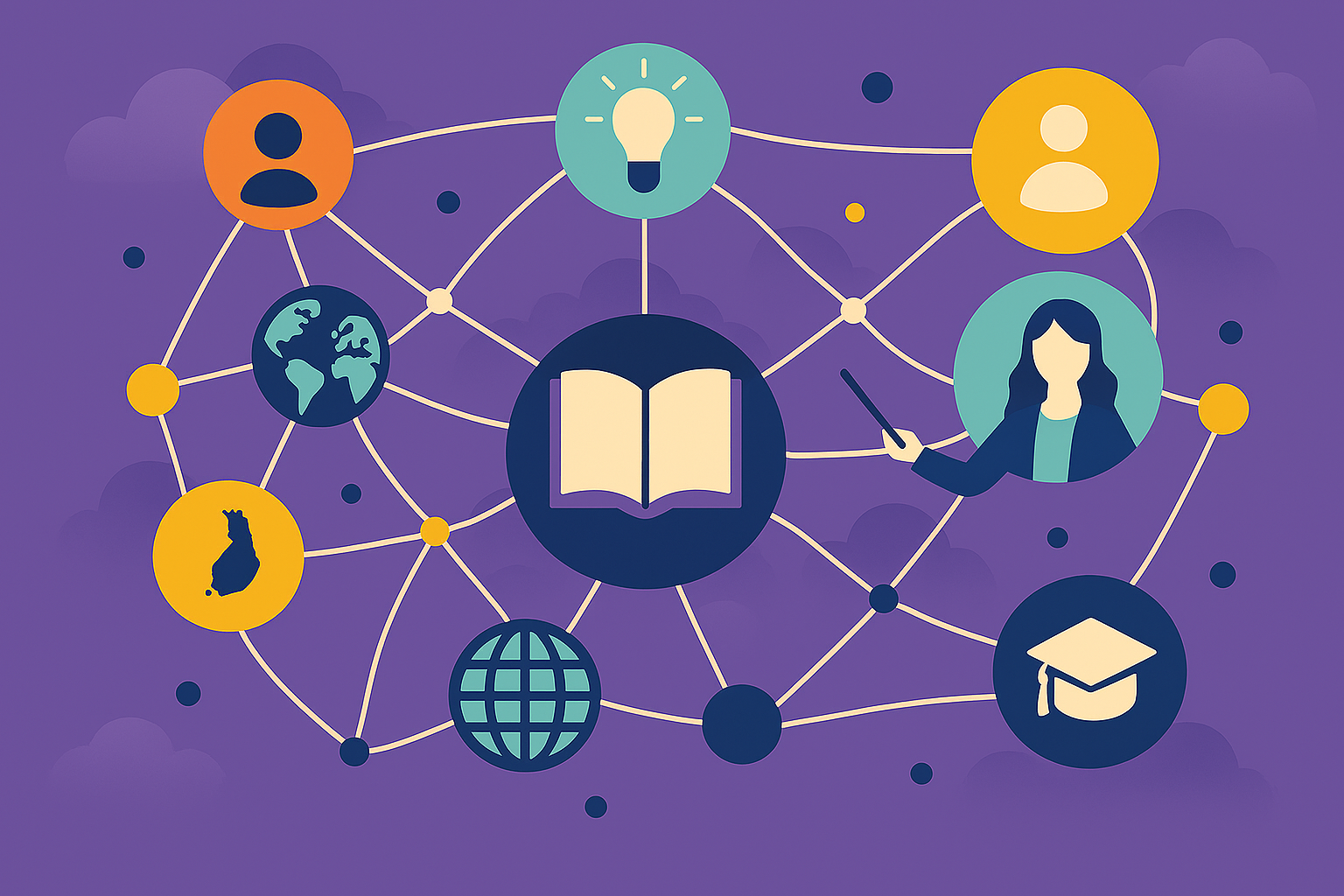
Transcript: Excellent Teacher Learning Happens in Networks
This is the transcript for podcast ”Excellent Teacher Learning Happens in Networks”
Sini: Excellent teacher learning happens in networks.
Sini: Welcome to Haaga-Helia Pedagogi podcast. Today we are talking about excellent teacher learning happens in networks. The podcast will be published in Pedagogi, the publication of Professional Teacher education at Haaga-Helia, University of Applied Sciences. I’m Sini Bask from the School of Professional Teacher Education here at Haaga Helia, and with me I have here my colleague.
Taina: Hello, my name is Taina Laivola.
Sini: We are joined by our network, both national and international. So, we have here Ami Toikka from Stadin ammattiopisto Helsinki Vocational College and also a visitor from Brazil, José Amado.
We’ll explore what makes network learning excellent: trust, dialogue, self-management, and also how teachers can build meaningful connections from different learning environments, from classrooms to companies to policymakers.
Taina: Yes, and we’ll keep it practical.We discuss how to enable teachers to network during their working hours and how international mobility, entrepreneurship modules or RDI projects can create lifelong ties.
And it’s also good to keep a focus on what kind of pedagogical methods we can use with students to improve their networking skills and help them network already during their studies.
Sini: So let’s dive in together. Ami, could you introduce yourself and your current focus on networks?
Ami: Yes, hi, I’m Ami Toikka, team leader at Helsinki Vocational College. Our team focuses on international affairs, sustainable development and future skills, as well as digital pedagogics.
I have been leading projects regarding study guidance, open vocational studies, internationally and nationally for years.So, actually there are lots of networks to talk about in this podcast.
00:02:38 Sini: How about you, José?
José: Hello, everyone. I’m a geography teacher in Brazil. I represent the federal network of educational professional, professional education at work.
It’s almost 700 schools now all over Brazil, offering either vet education or higher educational courses. And I’m collaborating with Haaga-Helia for the next few months as a part of my PhD in Brazil.
Taina: And I’m Taina Laivola, a teacher trainer at Haaga-Helia for the past six years, and previously I worked forwarded two decades at another applied university as a teacher, developer and leader of various projects.
Now my focus is on stakeholder engagement, alumni collaboration, creating contacts with needed organizations and companies, and collaborative RDI projects. Of course, like we all do here at Haaga-Helia.
Sini: Yes, that’s true. Many of those same things also apply to me, but my relationship now to networks comes naturally from a variety of perspectives, but one of my main focuses currently is coordinating the transnational partner network of our School of Professional Teacher Education and also student mobilities and all activities international within our team.
So we could state that here we have both institutional, interinstitutional and international networks represented in the context of education. Let’s start our examination by discussing the why. So, what is the purpose of networking for teachers and teacher students, Ami?
Ami: Well, actually, your goal or purpose defines the network. If, for example, the goal is internationalization or entrepreneurship, it shapes who you connect with.In our city own college, we benefit from broad municipal and industry ties. It opens up partnership possibilities, but also certain requirements.
Sini: How about in Brazil?
José: Yeah, I can say that in Brazil teaching is quite a lonely work to do. We usually, we plan alone, we assess alone, and we execute alone. And if you have a network mindsets, this can all change. Teachers can share materials, they can co-teach, co-assess. It’s a value that we should amplify and foster in teacher education.
00:05:31 Taina: Somehow teachers act as bridges between workplaces, teacher education, other universities and resources and students, future employers. They show students a diverse world of experts and prepare them for it.
I think so. And at the same time, teachers develop their own work and their own field and create projects for their universities or schools. Without these bridges, it’s hard to get excellent results at your work. It’s especially transition learners in the work life.
Sini: OK, and then from the why to the what. So, what makes network learning excellent rather than just busy?
Taina: First, trust. Long-term stable collaboration allows people to share best practices. their own competence and skills for common use without any fear. Sharing will be misused or work will not be divided fairly or you just give and not get enough, so on. So real co-development can happen when there is no fear about these kind of things at all, or a little bit.
José: Yeah, and I think we should add the dialogue competences to this level, like listening, valuing different views, adapting yourself to others’ ideas, and of course, adopt communication and collaboration as core values.
Sini: That’s true. And then to be able to be in that dialogue between different partners in the networks, you need self-management. So, one has to know which connections to strengthen and when to create new ones, and also to have the capacity to recognize opportunities for new connections within different networks and foster the already existing ones, even seek new fruitful territories for specific needs.
Ami: Yeah, plus multi-level collaboration. Colleagues, your organization and the broader ecosystem, like companies, municipalities and national requirements. Actually, policy only becomes reality when change agents on the ground implement it.
Sini: So, let’s get to the how. Let’s get concrete. What practices, in your opinion, help teachers and students grow their networks?
José: I think we can think of…network mapping exercises. If you don’t have a lot of resources, just take a sheet of paper, a pencil, and start drawing what your connections are.
If you think of something more concrete, you can use tags, yarns, and try to visualize your ties. Who could you plan a lesson with? Who could you interview for a competence module? Which links are weak and which are missing? And making each networks visible sparks your metacognition in your reflection?
00:08:56 Taina: Sounds familiar to me. We use similar activities in training weeks and in internet. National courses and students map existing ties decide which is to strengthen and identify missing links. In general, networking, like other key topics as well, must be found in curricula.
Then the development of networking skills will be real, and teachers will take it into the concrete and content of the programs in practice and answer calls for it.
Ami: Yes, and for example in entrepreneurship models, learners map their networks, where they will need as future entrepreneurs, customers, mentors, suppliers, regulators. And in study and career planning, they identify employers, further study parts and international opportunities.
Sini: So, how do we enable assessment? Because that’s important when we talk about excellent learning in networks. If students are assessed on networking, teachers need networking competence and transparent rubrics. They need to incorporate peer and self-assessment in their learning.
And in a sense, we can make a network excellent by doing that, incorporating assessment into its practice and thus enriching processes so that they actually become ecosystems for continuous learning for all its members.
Taina: And the core topic is how do we enable teachers to network during their working hours and working time? We all know how busy teachers are, and it’s hard to find time to visit partners or attend events and meet new people.
Ami: Exactly. Leaders have to kind of like legitimize it. Allocate time, set meeting spaces, and embed networking into team plans.
Some teachers are eager, while others are curious, but not cautious, and some prefer really not to recognize profiles and spend energy where it multiplies. Success attracts later adopters.
Sini: Yes, and also sharing over siloing. We teachers often have our own micro networks where we operate constantly, and we need ways to share these contacts that we have with colleagues and our students, so that the opportunities don’t depend on one person alone, and that’s kind of at the core of network work that we are within different kinds of networks at the same time and share everything.
José: Yeah, I totally agree with AMI with these free profiles of teachers and collaborators, the ones that are really eager to do something and are already doing, so you have to find them. The ones that they are eager to do, but they still don’t know exactly how, but they are looking for it, and the ones that are pretty resistant.
So, you have to really try to identify these three profiles, and strategic alignment helps with this. So, your personal network should also link to the institution’s vision, balancing significant long-term partners with local actors so you can get the whole community involved.
Sini: Yeah, I totally agree. So, one more thing would be the results, the outcomes of such working and such learning. What kind of learning do strong networks actually produce?
00:12:50 Ami: Well, actually, I could continue kind of like what José was talking about previously about the local actors, because for example, at our college, working placements often convert into paid positions. Students build professional customer networks. Some meet lifelong Friends abroad and return to work or study in the same country, gaining language and cultural capital.
Taina: And remember, networking is for everyone. You don’t have to be an extrovert, have any special skills or be in certain position when you’re developing your networks. Teachers can support first steps and provide safe entry points for their own students as a part of all studies.
José: Yeah, I think networking has this kind of a beautiful symmetry. You give and you take. Sometimes you give more, sometimes you take more. And may I quote Lennon and McCartney when they say that in the end, the love you take is equal to the love you make. I think this applies a lot to professional generosity too.
Sini: Yeah, that’s really, really beautifully said, José. And I also agree with Taina that our role as educators would be to kind of minimize the thresholds and give input to start the connection so that it’s easier for our students to then later on hang on and bring new networks into their learning, continuous learning.
So, at the end of the day, all these smaller local professional networks read the entire humanity, the global connection between all of us. Hence taking care of our own smaller networks that we are working in and learning in, we are creating excellent gossamers for humankind to capture what is needed for a good and sustainable life and future for everyone on a global scale.
In other words, the small networks become so-called local networks that connect local actions with global mindsets. And then our excellent learners in excellent learning environments and excellent networks for learning become global citizens who act responsibly toward all the humans on the earth.
So, it’s not only about producing something, it’s about sharing and maintaining connections that bring about spaces for living together peacefully and well. So, something needs to be taken away from the studio today and to be spread out into all of our networks. Maybe three things would be: map your network, make it visible. Choose which ties to strengthen and which to create.
Secondly, invest in truth and dialogue. So, be generous, share with colleagues and students and love enough to be able to receive love from the others as well.
And thirdly, align with purpose. So, connect your network building to curriculum goals, employability and institutional strategy. Or what do you think, Taina?
00:16:28 Taina: You sum up those key points very well. If you are a teacher, try 30-minute networking exercise this week. If you lead teams, set time slot in your meeting for networking so that it becomes part of everyone’s official work time. As usual, nothing will get done unless it’s made important and a specific time and place it set for it.
Ami: Yeah, and my point of view is to keep it multi-level, peer, organization and ecosystem.
José: And don’t be afraid to start. Start now. Make baby steps, don’t plan, don’t overplan the things. Keep it small, but start.
Sini: Trust your networks to help you in that process. So, thank you so much. Ami Toikka and José Amado for being here with us, and thank you Taina Laivola for being my colleague also in the next steps of our network creating.
You’ve been listening to Excellent Teacher Learning Happens in Networks in Pedagogi publication of Professional Teacher Education at Haaga-Helia University of Applied Sciences. Until the next time, keep building bridges.
Taina: Thank you, Sini for hosting us, and thank you José and Ami. It was nice to discuss with you.
Ami: Thank you all so much. It was nice, yes.
José: Thank you everyone! Até a próxima